
 Swedish
 French
 German
One Talent Crisis, Three Strategies: How Employer Branding Differs Across Europe, North America, and APAC
The global talent market is tightening. AI is reshaping skills requirements. Workforce expectations are shifting faster than most employer brands can keep up. But here’s what the data makes clear: how organizations respond to these pressures depends heavily on where they operate.

Drawing on Universum’s Employer Branding Now 2026 regional reports, this article breaks down the key differences shaping employer branding strategy across Europe, North America, and APAC — and what those differences mean for HR and EB leaders building competitive talent strategies today.
Hiring Climate: One Global Pressure, Three Different Intensities
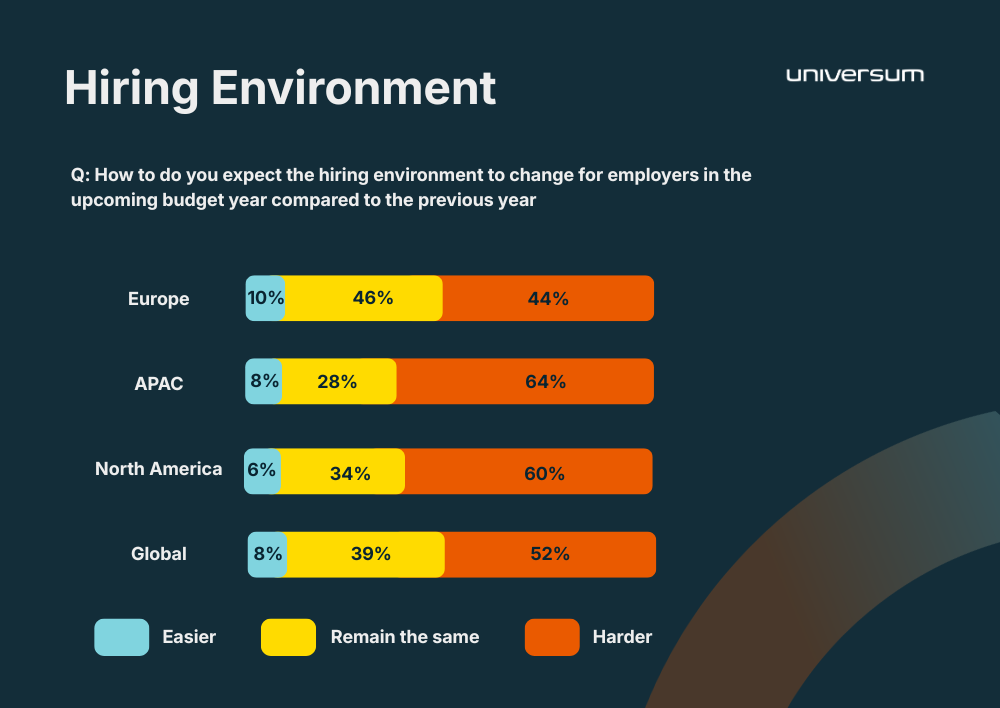
All three regions expect a tougher hiring environment in 2026. But the degree of difficulty varies significantly.
Europe is experiencing familiar pressure — persistent shortages in IT, digital, and engineering talent — but employers here have learned to operate within chronic scarcity. There’s resilience in the European outlook: steady adaptation rather than alarm.
North America faces sharper competition. Digital talent is fiercely contested, and the labor market is increasingly fluid. Workers expect faster career progression, greater flexibility, and stronger alignment between personal and organizational values. In a crowded field, getting noticed — let alone chosen — demands constant effort.
APAC faces the steepest climb. More than 60% of organizations in the region expect hiring conditions to worsen in 2026 — the highest rate globally. Shortages extend beyond digital roles into mid-management, logistics, and specialized functions. Rapid business growth, rising salary benchmarks, and head-to-head competition between global and local employers are all compounding the pressure.
The picture: talent scarcity is universal, but APAC’s version is broader, deeper, and accelerating faster.
Strategic Priorities: Different Regions, Different Employer Branding Philosophies
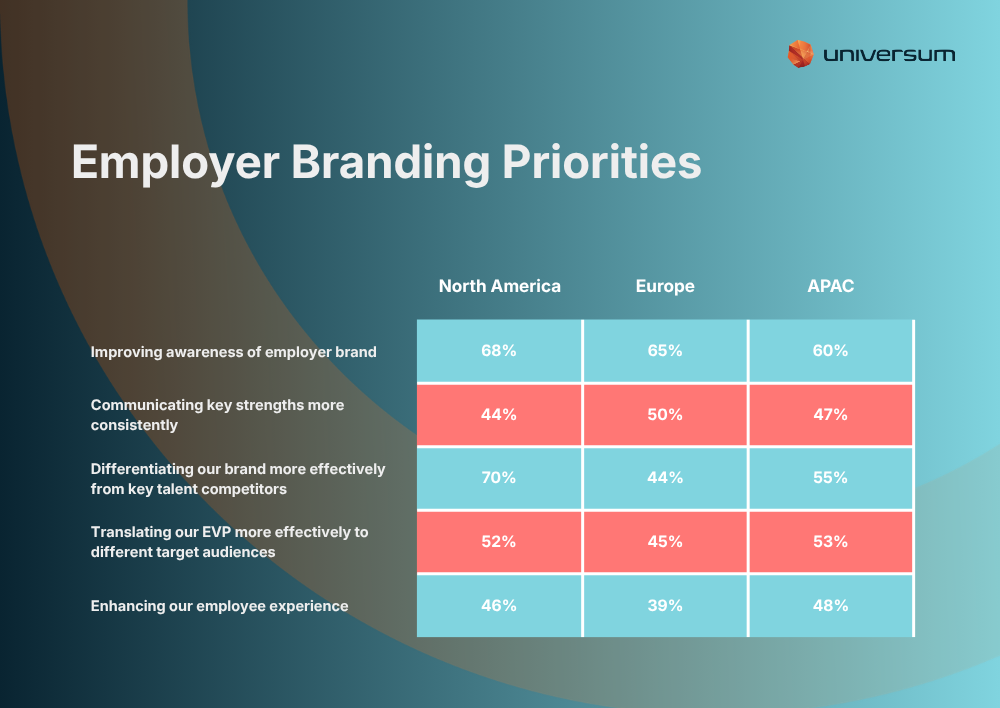
Employer branding is now a strategic priority across all three regions. But what that strategy looks like — and what it’s trying to achieve — differs sharply.
North America is focused on differentiation. In a market saturated with recognizable brands, standing out matters as much as what you stand for. Companies invest in bold storytelling, digital engagement, and reputation-building that makes them unmistakably distinct. The tone is confident and performance-oriented: impact, innovation, high-achieving cultures.
Europe takes a more deliberate approach. Awareness matters, but the real priority is internal coherence — translating the EVP consistently across audiences, communicating authentically, and building long-term talent relationships rather than chasing quick acquisition wins. European employer brands favor depth and sustainability over reach and speed.
APAC occupies a compelling middle ground. Differentiation and awareness are both priorities, but so is employee experience. APAC employers know their talent is motivated by growth, learning, and upward mobility — and their messaging reflects it. Career acceleration, development opportunities, and innovation-driven cultures dominate the narrative. APAC employer brands don’t just attract talent; they promise a platform for it.
Put simply: North America sells uniqueness. Europe sells authenticity. APAC sells opportunity.
What Talent Wants: Regional Differences in Candidate Qualities and Expectations
What employers look for in candidates — and what candidates expect in return — varies significantly by region.
Europe prizes collaboration. Workplace culture here tends to favor consensus-building, cross-functional teamwork, and stable organizational structures. Employers want people who can integrate, contribute collectively, and grow within the system. Responsibility, adaptability, and accountability are defining traits.
North America leads with performance and independence. Results-focus, problem-solving, and personal integrity top the wish list. Companies want individuals who deliver impact quickly, navigate ambiguity confidently, and take ownership without heavy oversight. Measurable outcomes drive everything.
APAC prioritizes growth potential over tenure. Learning agility, proactivity, and creativity are highly prized — fitting for markets undergoing rapid economic, technological, and business transformation. APAC employers are notably open to high-potential early-career talent, reflecting a dynamic and upward-moving market.
The implication: your ideal candidate persona isn’t universal. It’s shaped by culture, market stage, and regional expectations. Building accurate talent personas means accounting for these differences — not flattening them.
EVP Attributes: What Each Region Actually Offers Its Candidates
North America: Innovation Dominates by a Wide Margin
The single most striking data point in the EVP comparison: North American employers include Innovation in their EVP at a rate of 53% — a full 23 percentage points above the global average, and far ahead of Europe (29%) and APAC (32%). In a market defined by disruption, speed, and competitive differentiation, positioning as an innovative employer isn’t aspirational — it’s table stakes.
North America also significantly overindexes on Competitive Benefits (+16% vs global) and Recognition for Performance (+11%) — reflecting a market where total compensation packages, individual visibility, and a culture of achievement are central to the employment deal. Notably, Learning and Development ranks only 5th (34%), some 11 points below the global average — a reminder that North American EVPs lead with output, not development.
Europe: A Human-Centered EVP Built Around People and Purpose
Europe’s top EVP attributes — Learning and Development (47%), Collaborative Work Environment (44%), Meaningful Mission (38%), and Work-Life Balance (25%) — tell a coherent story: the European employer promise is fundamentally people-centered.
Europe overindexes on Collaborative Work Environment (+4% vs global) and Meaningful Mission (+3%), while Work-Life Balance appears as a priority that is largely absent from APAC EVPs. This aligns closely with European workplace culture: stability, purpose, and sustainable working conditions are core to the employment deal — not perks layered on top of it. Compensation, by contrast, barely registers: Competitive Salary ranks 24th in Europe, cited by just 4% of employers.
APAC: Growth-First, with a Significant Bet on DEI
APAC employers lead all three regions in prioritizing Career Growth Opportunities (#1 at 45%, +5% vs global) — entirely fitting for a market defined by rapid economic expansion and upwardly mobile workforces. But the standout finding is elsewhere: Diversity, Equity and Inclusion ranks 4th in APAC at 31%, a +9 percentage point overindex versus the global average — the largest regional overindex of any single EVP attribute across any region in the dataset.
As APAC organizations expand internationally and compete for global talent, inclusive workplace positioning is becoming a genuine differentiator, not just a compliance checkbox. One notable contrast: Work-Life Balance is significantly underrepresented in APAC EVPs (15%, −7% vs global) — reflecting a market culture that still tilts strongly toward ambition and advancement over boundaries and recovery time.
The One Thing All Three Regions Agree On: Salary Is Not the Story
Across all three regions, Competitive Salary ranks last or near last as an EVP attribute: 24th in Europe (4%), 20th in North America (4%), 21st in APAC (6%). The signal is consistent: employers have largely stopped leading with pay. EVP is about culture, growth, and purpose. If salary is still your primary employer brand message in 2026, you’re already behind.
Technology in Employer Branding: Three Speeds of Digital Transformation
HR technology and digital transformation are accelerating employer branding globally, but at very different rates across regions.
North America leads in both maturity and breadth. Generative AI, CRM platforms, AI-driven sourcing, and programmatic advertising are all running above the global average. Technology isn’t an experiment here — it’s infrastructure. The focus is on system integration, pipeline optimization, and scaling personalization at speed.
Europe follows at a measured pace, shaped by robust privacy regulations, structured governance, and a culture of careful experimentation. Generative AI adoption is solid; more advanced tools like AI-based candidate matching are still emerging. European employers want technology that enhances experience without compromising compliance or authenticity.
APAC is the region to watch. Less mature than North America overall, but more experimental than either Western region, APAC organizations lead in AI-driven sourcing and VR/AR recruitment — tools that remain niche elsewhere. With rapid economic growth, younger workforces, and fewer legacy system constraints, APAC is well-positioned to leapfrog traditional markets in HR technology within the next two to three years.
Recruitment Channels: Where Talent Actually Pays Attention
Knowing where to show up is as important as knowing what to say. And the channels that reach talent effectively differ dramatically by region.
Europe favors in-person events and employer career sites. Physical touchpoints reflect strong university networks, established talent fairs, and cultural norms that value direct, personal engagement.
North America leans into professional referrals and online events. Remote-friendly practices and large professional networks have made digital-first recruitment the default. Virtual formats allow companies to reach talent efficiently across vast geographic footprints.
APAC is most active on social networks and job boards. Mobile-first, digitally fluent populations use these platforms as their primary window into career opportunities. Job boards remain powerful for experienced professionals; social media handles both branding and early-career engagement simultaneously.
The takeaway: your global channel strategy must flex to regional behaviors — not the other way around.
Measuring Success: Regions at Different Data Maturity Levels
How companies measure employer branding success reveals as much about their strategic maturity as any other signal.
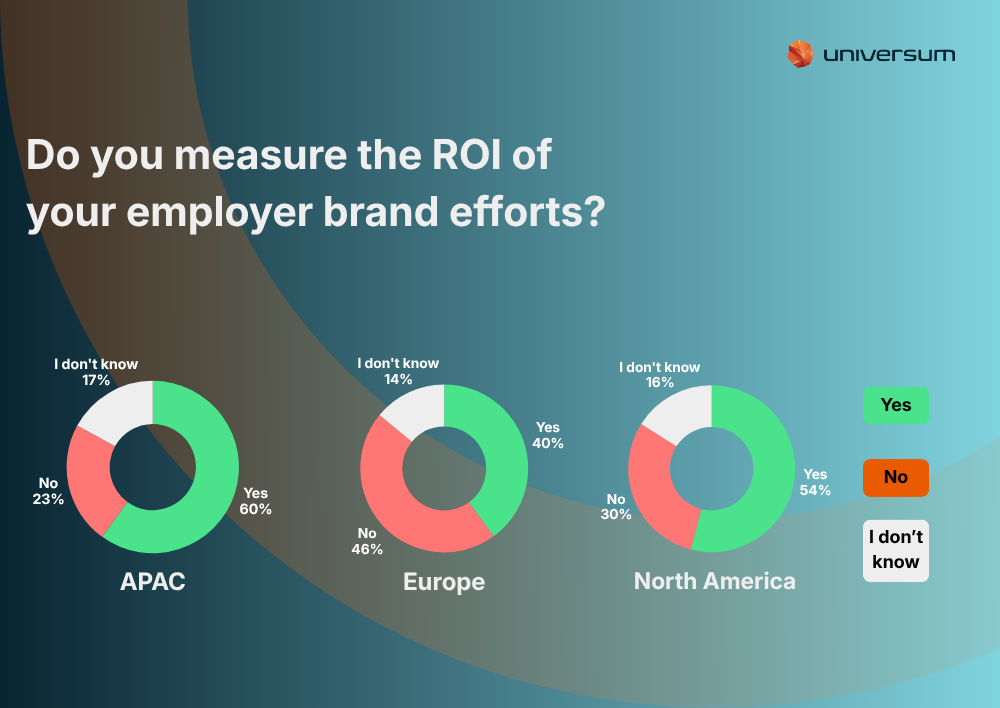
North America leads with sophisticated analytics, tracking digital engagement, cost-per-hire, time-to-hire, and employee advocacy. Measurement is frequent, structured, and embedded in decision-making.
Europe measures consistently but centers on long-term brand health indicators: awareness, applicant volumes, and engagement. The approach is data-informed but less conversion-driven, reflecting a longer-horizon view of talent attraction.
APAC blends both — strong on recruitment performance metrics, still developing advanced ROI modeling. As HR technology adoption accelerates across the region, measurement sophistication is set to follow quickly.
One Employer Brand, Many Local Executions
The clearest message from Universum’s Employer Branding Now 2026 regional reports: employer branding must be globally aligned but locally executed.
Europe demonstrates the power of authenticity, stability, and long-term trust. North America shows the value of clarity, differentiation, and data-driven execution. APAC reflects the energy of growth, agility, and relentless forward momentum.
The organizations that will win the talent competition in 2026 and beyond are those that hold both truths at once: a coherent employer brand at the core, and the flexibility to adapt it meaningfully in every market they compete in.
Want to understand how your employer brand performs by region? Explore the full Employer Branding Now 2026 reports from Universum for deep-dive data on Europe, North America, and APAC.
